Artificial Intelligence
From applied machine learning to AI systems that drive real decisions
Our team began working with applied machine learning in 2016, long before large language models and generative AI entered mainstream use. Our early work focused on production grade systems, not experiments, delivering measurable outcomes across fintech, HRTech, AR, gaming, and SaaS.
From the start, our approach to AI has been pragmatic. Models exist to support decisions, reduce noise, and improve execution. Everything else is secondary.
Intelligence that earns trust
AI only creates value when people rely on it. That requires systems that are transparent, predictable, and aligned with real world workflows.
We design AI that integrates directly into how teams already work, supporting focus, prioritization, and action rather than adding more dashboards or alerts. The goal is not automation for its own sake, but better decisions at the right moment.
This philosophy is the foundation behind products like Kingo AI.
Turning daily chaos into clear direction
Kingo AI was built to solve a problem we experienced first hand as founders and operators. Too much information, too many tools, and not enough clarity on what actually matters each day.
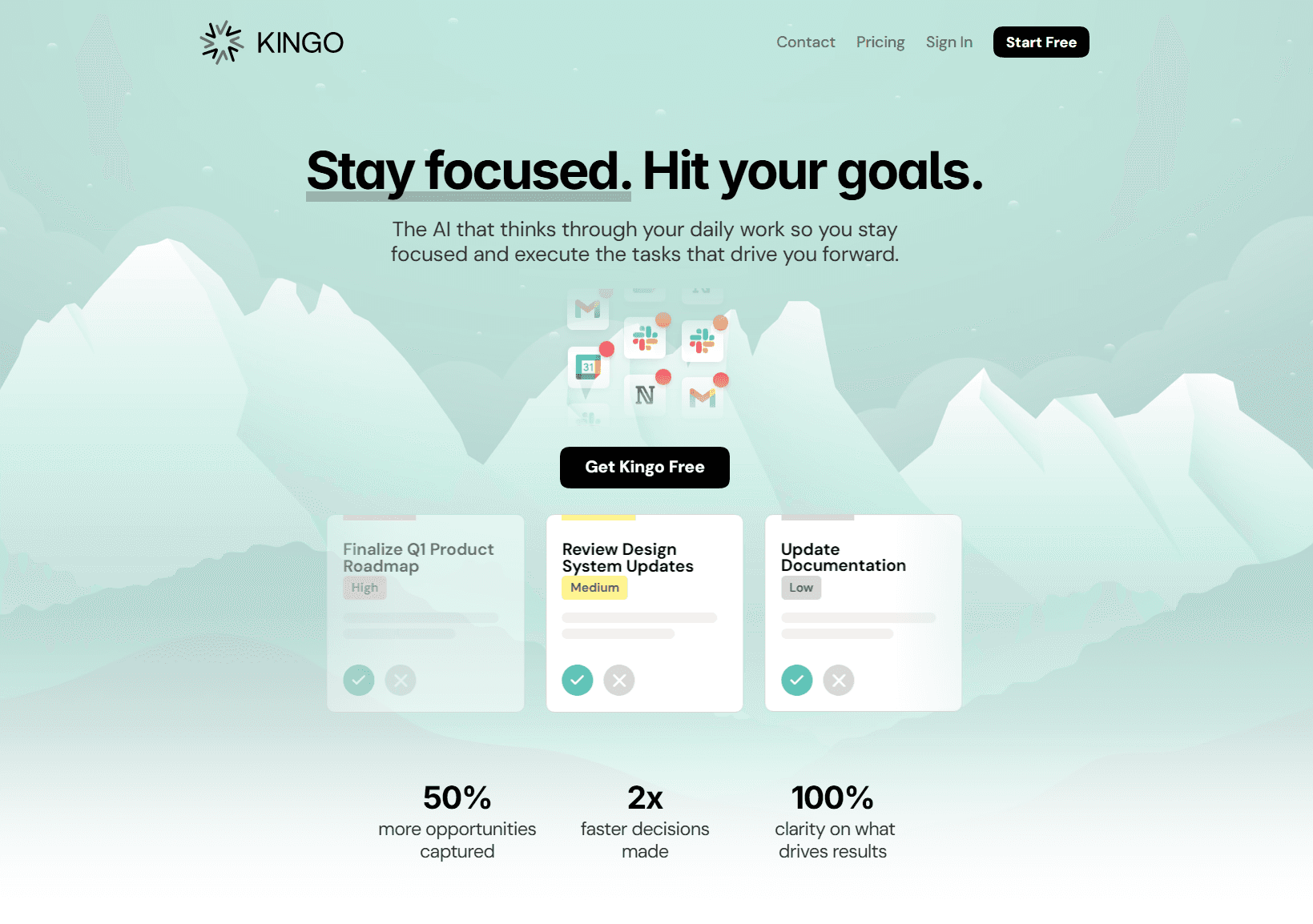
Kingo connects to the systems teams already use, including email, task management, and internal tools. It analyzes signals, context, and intent to surface the right actions, summaries, and reminders.
The result is calmer execution, fewer missed opportunities, and sustained progress toward long term.
Shipping matters more than novelty
We specialize in taking AI from research to production. That means model selection, system architecture, data pipelines, evaluation loops, and long term maintenance.
We focus on reliability, cost efficiency, and alignment with business outcomes. AI that cannot be trusted or maintained has no place in serious organizations.
Our teams have deployed AI systems used daily by thousands of users across multiple industries.
Staying grounded in fundamentals
Alongside applied work, we collaborate with academic researchers on advanced AI topics, including computer vision, multimodal systems, and applied intelligence for regulated environments.
These collaborations inform how we design scalable architectures and evaluate models under real world constraints, particularly in areas such as surveillance, medical imaging, and industrial quality control.
Research informs practice, but practice always leads.
From tools to decision infrastructure
The next phase of AI is not more features. It is better judgment at scale.
We are focused on building systems that act as a reasoning layer across tools, data, and goals. AI that understands context, tracks intent over time, and supports humans in making fewer, better decisions.
This is where applied AI becomes foundational infrastructure.
Portfolio